

Aluminum vs. Steel Enclosed Trailers: The Honest Buyer’s Guide
Buying Guide • July 2026 • 27 min read
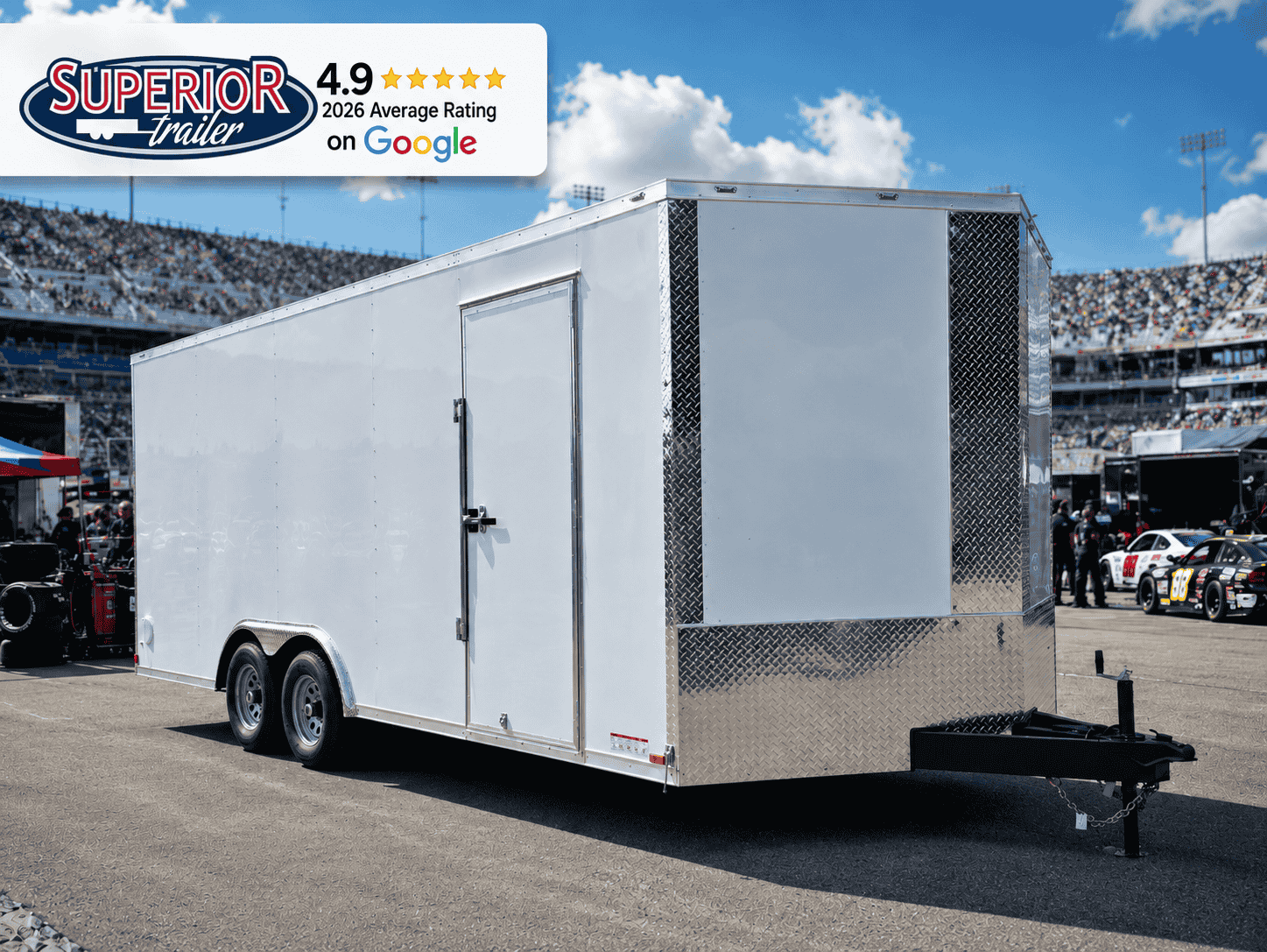
Aluminum or steel?
It sounds like a simple question until you start comparing actual enclosed trailers. One model may have an aluminum exterior but a steel frame. Another may use aluminum throughout the frame, walls, roof structure, and exterior. Two trailers can look nearly identical from across the lot while being built very differently underneath the skin.
That difference affects more than appearance. It can change the trailer’s empty weight, usable payload, purchase price, resistance to corrosion, repair options, resale value, and the type of tow vehicle needed to move it comfortably.
The honest answer is that neither material wins every comparison.
A properly built steel-frame enclosed trailer can be an excellent working trailer for contractors, landscapers, mobile businesses, homeowners, and equipment owners. An all-aluminum enclosed trailer may be the better investment for someone towing near a vehicle’s limits, operating around coastal salt and humidity, or planning to keep the trailer for many years.
The best choice depends on where the trailer will live, what it will carry, how often it will be used, and how much you want to spend upfront.
Superior Trailer helps buyers compare enclosed cargo trailers in person at locations in Burlington, North Carolina, and Virginia Beach, Richmond, and Suffolk, Virginia. Instead of choosing from a photograph or a material name alone, buyers can compare construction, payload, doors, flooring, axles, interior height, and available options before making a decision.
First, Understand What “Steel Trailer” Usually Means
When people hear “steel enclosed trailer,” they often picture a trailer covered in steel panels.
That is not always what is being sold.
Many mainstream enclosed cargo trailers combine a steel frame with aluminum exterior panels. The steel frame performs most of the structural work, while the aluminum panels form the exterior walls.
An all-aluminum enclosed trailer generally uses aluminum for substantially more of the structure, including the main frame, wall posts, roof bows, crossmembers, or other structural components, depending on the manufacturer and model.
This distinction matters because the outside of two trailers may both look like aluminum. You have to inspect the frame and specifications to know what you are actually comparing.
Before buying, ask the dealer:
- Is the main chassis steel or aluminum?
- What material is used for the wall posts and roof structure?
- Are the floor crossmembers steel or aluminum?
- What material is used for the exterior panels?
- Is the rear ramp structure steel or aluminum?
- Are any dissimilar metals isolated to reduce galvanic corrosion?
- What is the trailer’s listed empty weight?
- What is its certified payload capacity?
Do not rely on the word “aluminum” in an advertisement without finding out which parts of the trailer are aluminum.
Quick Comparison: Aluminum vs. Steel Enclosed Trailers
| Comparison | Steel-frame enclosed trailer | All-aluminum enclosed trailer |
|---|---|---|
| Initial purchase price | Usually lower | Usually higher |
| Empty trailer weight | Generally heavier | Generally lighter |
| Available payload at the same GVWR | Usually lower | Often higher |
| Red rust on the main frame | Possible if coatings are damaged | Aluminum does not develop red iron rust |
| Coastal and road-salt use | Requires more cleaning and inspection | Generally better corrosion resistance |
| Structural repairs | Steel welding is widely available | Requires proper aluminum repair experience |
| Resistance to dents | Depends on member size and construction | Depends on alloy, extrusion and construction |
| Long-term maintenance | Frame coatings and rust need attention | Lower rust-related maintenance, but not maintenance-free |
| Upfront value | Strong choice for budget-focused buyers | Strong choice for long-term and weight-focused buyers |
| Typical customer | Contractors, homeowners, general cargo users | Racers, coastal buyers, frequent travelers and long-term owners |
The table gives you the general direction, but it should not replace a model-to-model comparison. A well-engineered steel trailer may be a better purchase than a poorly equipped aluminum trailer, and the same is true in reverse.
Is Aluminum Always Lighter Than Steel?
Aluminum is a lower-density material than steel, so an aluminum structure can often be designed with less finished weight. That does not mean every aluminum trailer is automatically lighter than every steel trailer.
Trailer weight is also affected by:
- Overall length and width
- Interior height
- Frame-member dimensions
- Axle count
- Flooring thickness
- Ramp-door construction
- Cabinets and workbenches
- Air conditioning
- Generators and batteries
- Spare tires
- Finished walls and ceilings
- Electrical packages
- Winches and tie-down systems
A basic steel-frame 6-by-12 cargo trailer can weigh less than a fully finished aluminum race trailer simply because the aluminum trailer is much larger and carries more equipment.
The correct comparison is between trailers of similar size, GVWR, axle count, interior height, door configuration, flooring, and installed options.
All-aluminum manufacturers emphasize lower structural weight as one of the material’s main advantages. For example, inTech describes its trailers as using fully welded, all-tube aluminum construction, while LOOK’s Vision enclosed cargo line uses all-aluminum construction across models with GVWRs from 2,990 to 9,900 pounds.
Why Empty Trailer Weight Matters
A lighter trailer can help in three important ways.
More Usable Payload
Payload is not the same as GVWR.
GVWR is the maximum rated weight of the loaded trailer. The trailer itself uses part of that rating before you load the first tool, machine, motorcycle, or pallet.
Use this calculation:
GVWR − empty trailer weight = estimated payload capacity
Suppose two trailers both have a 7,000-pound GVWR.
If the first trailer weighs 2,500 pounds empty, it has an estimated 4,500 pounds of payload.
If the second weighs 2,000 pounds empty, it has an estimated 5,000 pounds of payload.
That extra 500 pounds can be meaningful when the trailer carries tools, cabinets, spare parts, fuel, equipment, or inventory every day.
Always check the actual VIN label and manufacturer specifications. Optional equipment can increase the empty weight and reduce the payload available to the customer.
More Towing Flexibility
A lighter empty trailer may work with a broader range of properly equipped tow vehicles.
That does not mean an aluminum trailer automatically makes an undersized truck safe. You still need to verify:
- Maximum trailer rating
- Vehicle payload
- Gross vehicle weight rating
- Gross combined weight rating
- Hitch rating
- Receiver rating
- Tire ratings
- Axle ratings
- Loaded tongue weight
A half-ton truck may have an impressive advertised tow rating but limited remaining payload after passengers, tools, fuel, accessories, and trailer tongue weight are added.
Easier Low-Speed Handling
A lighter trailer can be easier to position by hand, move around a shop, or maneuver through a tight storage area. The difference becomes more noticeable with smaller single-axle cargo trailers.
Once a trailer is heavily loaded, however, cargo placement, axle setup, tire pressure, hitch height, and tongue weight have a much greater effect on towing behavior than frame material alone.
Is Steel Stronger Than Aluminum?
This question creates more confusion than almost any other part of the comparison.
Steel and aluminum have different material properties, but a completed trailer is not judged by a pound-for-pound sample of raw metal. It is judged by how the entire structure was engineered and manufactured.
An aluminum trailer may use larger tubing, proprietary extrusions, different wall thicknesses, additional bracing, and fully welded cage construction to achieve the intended strength while keeping weight down.
A steel trailer can use smaller structural members because of steel’s material properties. Steel is also familiar to fabricators and is often economical to manufacture.
That means you should not make the decision by saying “steel is stronger” or “aluminum is better.” Instead, compare the completed trailers:
- Certified GVWR
- Payload capacity
- Main-frame design
- Tongue construction
- Floor crossmember spacing
- Wall-post spacing
- Roof-bow spacing
- Ramp-door rating
- Axle ratings
- Tire and wheel ratings
- Floor thickness
- Warranty coverage
- Intended use
An engineered all-aluminum trailer can safely perform demanding commercial or motorsports work when it is used within its ratings. Likewise, a properly constructed steel-frame trailer can provide years of reliable heavy use.
Material is only one part of the design.
Which Trailer Handles Rust and Corrosion Better?
This is where aluminum has its clearest advantage.
Steel can rust when moisture and oxygen reach unprotected metal. Paint, powder coating, galvanizing, primers, and undercoating can slow that process, but scratches and exposed areas still require attention.
Road salt makes the situation worse. Salt and moisture can collect around:
- Welds
- Fastener holes
- Tongue assemblies
- Crossmembers
- Axle mounting points
- Door frames
- Seams
- Areas hidden above the axles
- Places where debris remains trapped
Aluminum does not develop the red iron oxide commonly called rust. It naturally forms a thin oxide layer that helps protect the material underneath. That gives properly designed aluminum trailers an advantage in humid, wet, or salty environments.
Aluminum is not completely immune to corrosion, though.
It can experience pitting, crevice corrosion, or galvanic corrosion under certain conditions. Galvanic corrosion may occur when aluminum and a dissimilar metal remain in electrical contact in a wet, corrosive environment. Proper fasteners, coatings, isolating materials, drainage, cleaning, and manufacturer design all matter.
Calling an aluminum trailer “maintenance-free” would be misleading. It still needs washing, inspection, lubrication, seal maintenance, bearing service, brake work, tire replacement, and electrical repairs.
It simply avoids much of the red-rust problem associated with exposed steel.
Which Material Is Better Near the Virginia or North Carolina Coast?
Buyers in Virginia Beach, Hampton Roads, the Outer Banks, coastal North Carolina, and other humid or salt-exposed areas should give corrosion resistance serious consideration.
A trailer does not have to be backed into the ocean to experience salt exposure. Moist coastal air, wet storage areas, boat ramps, winter road treatments, and salt carried on the tow vehicle can all reach the trailer’s underside.
An all-aluminum frame can make sense when:
- The trailer will remain outside
- It will be used around marinas or boat ramps
- The owner lives close to salt water
- Winter roads are regularly treated
- The trailer will be kept for many years
- The owner wants to reduce rust-related frame maintenance
A steel-frame trailer can still perform well in these conditions, but the owner should rinse the underside, inspect damaged coatings, keep drains and seams clear, and address surface rust before it spreads.
For a trailer stored indoors in Burlington, Richmond, or another inland area and used only occasionally, the additional cost of all-aluminum construction may be less important.
Storage conditions can matter almost as much as driving conditions.
Do Aluminum Trailers Get Better Fuel Mileage?
A lighter trailer may reduce the amount of work required to accelerate and climb hills. However, it is not responsible to promise a specific fuel-mileage improvement.
At highway speed, aerodynamic drag can be a major factor. Trailer height, width, nose design, roof equipment, tow speed, wind, tire pressure, cargo weight, truck configuration, and driving habits can all affect fuel use.
An aluminum trailer’s lower weight is most likely to be noticed during:
- Stop-and-go driving
- Acceleration
- Hill climbing
- Frequent local deliveries
- Towing with a smaller vehicle
- Trips where the trailer is lightly loaded
The safest way to view potential fuel savings is as a possible secondary benefit—not the only reason to spend more on an aluminum trailer.
Are Steel Trailers Easier to Repair?
Steel fabrication and welding services are more widely available in many areas. That can make a steel-frame trailer easier to repair locally after structural damage.
Aluminum repairs require the correct equipment, material knowledge, preparation, and welding skill. A poor aluminum repair can create additional problems rather than restoring the original strength.
This does not make aluminum impossible to repair. It means the repair should be completed by a shop experienced with aluminum trailer construction and the manufacturer’s repair requirements.
The type of damage also matters.
Replacing an exterior aluminum panel is different from repairing:
- A bent tongue
- A cracked main-frame member
- A damaged roof rail
- A twisted ramp-door frame
- A broken crossmember
- Collision damage around an axle mount
Before buying either material, ask where the nearest qualified repair facility is located and whether the manufacturer can provide replacement components or repair guidance.
Superior Trailer offers parts and service support for trailers at its Virginia and North Carolina locations, including help with electrical systems, axles, brakes, suspension, floors, tires, body repairs, and general maintenance.
Which Trailer Is Better for Heavy Daily Work?
A steel-frame enclosed trailer is often the practical choice for a buyer who expects rough daily use and wants to keep the initial cost under control.
That can include:
- Construction crews
- Landscaping companies
- Mobile maintenance teams
- Flooring installers
- Restoration companies
- Moving businesses
- Property-maintenance crews
- Contractors hauling tools and materials
Steel-frame models are widely available in basic work configurations. The lower purchase price can leave room in the budget for ladder racks, shelving, E-track, cabinets, extra lighting, upgraded flooring, or a generator package.
An all-aluminum trailer can also handle commercial work, provided it was designed for the job. It may be especially valuable when the trailer travels long distances, operates near the coast, carries expensive equipment, or must stay under a specific combination weight.
The better question is not, “Which material can work?”
Both can.
The better question is, “Which completed trailer has the ratings and construction required for my work?”
Which Trailer Is Better for Landscaping?
For a landscaper carrying mowers, trimmers, blowers, fuel cans, hand tools, and small equipment, either material may work.
A steel-frame trailer is often attractive when:
- Upfront cost is the main concern
- The trailer will be replaced every few years
- The tow vehicle has plenty of capacity
- The trailer will receive hard daily use
- Local repair availability is important
An aluminum trailer may make more sense when:
- The towing vehicle has limited available payload
- The trailer operates near salt water
- The owner wants to keep it for a long time
- Reducing empty weight creates room for more equipment
- Appearance and resale value are important
Landscapers should also compare ramp angle, ramp-door capacity, side-door placement, interior height, ventilation, floor strength, wall-post spacing, and tie-down options.
Those features may affect daily productivity more than the frame material.
Which Trailer Is Better for a Mobile Business?
Mobile detailing, pressure washing, dog grooming, repair, vending, and service businesses often add substantial permanent equipment to an enclosed trailer.
That equipment may include:
- Water tanks
- Generators
- Compressors
- Shelving
- Cabinets
- Batteries
- Inverters
- Air conditioning
- Plumbing
- Workbenches
- Interior wall coverings
- Advertising wraps
Every permanent addition reduces available payload.
An all-aluminum trailer’s lower starting weight may provide more room for a build-out before reaching the GVWR. However, buyers should obtain the finished trailer’s actual weight after the conversion is complete.
A public vehicle scale is one of the best tools available to a mobile-business owner. Weigh the complete setup with normal fluids, supplies, tools, passengers, and cargo rather than estimating.
Which Trailer Is Better for Cars and Racing?
All-aluminum enclosed trailers are popular with racers because lower empty weight can help preserve payload for the vehicle, tools, tires, fuel, cabinets, and pit equipment.
Buyers should still compare:
- Ramp-door rating
- Ramp angle
- Escape-door placement
- Interior width
- Fender-box height
- Floor construction
- Tie-down locations
- Winch placement
- Cabinet weight
- Air-conditioning preparation
- Generator storage
- Axle ratings
Superior Trailer’s inventory includes enclosed car and racing trailers from brands such as Bravo and inTech. inTech describes its motorsports trailers as using fully welded all-aluminum construction, while Superior Trailer has also listed aluminum Bravo Silver Star enclosed models in its Burlington inventory. Availability changes as trailers are sold.
Does Aluminum Hold Its Resale Value Better?
All-aluminum trailers often attract buyers who are concerned about weight and rust. That can support used values, particularly in coastal areas, the Northeast, and markets where winter salt exposure is common.
However, material alone does not determine resale value.
A clean steel-frame trailer with service records, good tires, a solid floor, dry interior, straight axles, and no structural corrosion may be worth more than a neglected aluminum trailer with leaks, damaged panels, worn brakes, and poor repairs.
The factors that influence resale include:
- Brand reputation
- Trailer age
- Overall condition
- Frame condition
- Water intrusion
- Tire age
- Brake and bearing maintenance
- Floor condition
- Installed accessories
- Title status
- Local demand
- Quality of previous modifications
Buyers paying a premium for aluminum should think about the entire ownership period, not just the price on purchase day.
How Much More Does an Aluminum Enclosed Trailer Cost?
All-aluminum trailers generally carry a higher initial price than comparable steel-frame models. The exact difference depends on size, brand, frame design, axle capacity, finish, doors, interior equipment, and custom options.
A small basic cargo trailer and a premium aluminum motorsports trailer are not direct competitors, even though both are enclosed.
Current Superior Trailer listings illustrate how wide the enclosed-trailer market can be. As of July 15, 2026, a new 2026 Anvil 6-by-12 enclosed cargo trailer was listed at $4,550 in Burlington. A much larger 2025 Bravo Aluminum Silver Star 8.5-by-24 10K enclosed trailer was listed at a $22,299 clearance price. These examples should not be used as a direct aluminum-versus-steel price comparison because their sizes, GVWRs, features, and intended uses are different. They simply show why buyers need to compare complete specifications rather than material names alone.
Inventory, sale pricing, rebates, and financing programs can change. Contact Superior Trailer for current availability and an out-the-door quote.
Is the Higher Aluminum Price Worth It?
The additional cost may be justified when several aluminum advantages apply to the same buyer.
All-aluminum deserves serious consideration when:
- Your tow vehicle is close to its payload or towing limits
- You need to preserve as much cargo capacity as possible
- You live near the coast
- The trailer will see road salt
- The trailer will stay outdoors
- You travel long distances frequently
- You expect to own it for ten years or longer
- You care strongly about resale value
- You are protecting high-value cars or equipment
- You prefer premium fit, finish, or customization
Steel-frame construction may be the smarter purchase when:
- You need the lowest practical upfront cost
- Your truck has plenty of capacity
- The trailer will be stored indoors
- You operate mostly in dry inland conditions
- You expect rough commercial use
- Local repair availability is a priority
- The trailer will be replaced within a shorter ownership cycle
- Spending more would reduce the budget for necessary work equipment
The more important point is this: do not buy an aluminum trailer simply because someone told you aluminum is always better.
Pay more only when the advantages solve a real problem for you.
New Versus Used: What Should You Inspect?
Material affects the inspection, but both trailer types need a careful evaluation.
Inspecting a Used Steel-Frame Enclosed Trailer
Look closely at:
- Main frame rails
- Tongue and coupler area
- Welds
- Crossmembers
- Axle mounting points
- Rear-door frame
- Jack mounting plate
- Underside of the floor
- Areas hidden behind trim
- Scratched or flaking coatings
- Rust around fasteners and seams
Surface rust does not always mean the trailer is structurally damaged. Heavy scaling, deep pitting, cracks, deformation, or significant metal loss deserve professional attention.
Inspecting a Used Aluminum Enclosed Trailer
Look for:
- Cracks around welds
- Distorted frame members
- White corrosion deposits
- Pitting
- Loose or elongated fastener holes
- Damage where steel and aluminum meet
- Poor previous weld repairs
- Buckled wall posts
- Bent ramp-door framing
- Water trapped around seams or hardware
Inspecting Either Trailer
Check:
- Roof and corner seals
- Water stains
- Soft flooring
- Ramp-door cables and springs
- Hinges and latches
- Wheel bearings
- Brakes
- Breakaway system
- Tires and date codes
- Lights and wiring
- Axle alignment
- Uneven tire wear
- VIN label
- Title
- Actual empty weight and payload
A clean exterior can hide structural problems. Take enough time to inspect underneath the trailer and inside the corners.
Aluminum vs. Steel Enclosed Trailer: Our Verdict
For the majority of buyers who need a dependable enclosed work trailer at a practical price, a well-built steel-frame trailer remains a strong choice.
It is widely available, generally costs less, can be repaired by more fabrication shops, and can provide years of service when it is kept clean and protected from corrosion.
An all-aluminum enclosed trailer becomes especially attractive when weight, corrosion resistance, long-term ownership, premium construction, or coastal use matters more than the lowest upfront price.
Neither choice should be made from material alone.
Compare the actual trailer’s:
- Empty weight
- Payload
- GVWR
- Axles
- Tires
- Frame design
- Crossmember spacing
- Interior dimensions
- Door ratings
- Warranty
- Installed equipment
- Price
A trailer that fits your cargo and tow vehicle is a better purchase than a trailer made from the “right” material but equipped for the wrong job.
Why Buy an Enclosed Trailer From Superior Trailer?
Buying an enclosed trailer is not only about choosing a box with wheels. The trailer may protect thousands of dollars in tools, equipment, inventory, motorcycles, vehicles, or business supplies.
Superior Trailer helps customers compare the details that affect real ownership:
- Steel-frame and aluminum trailer options
- Single- and tandem-axle configurations
- GVWR and payload
- Cargo and car-hauler models
- Ramp doors and rear barn doors
- Side-door placement
- Interior height
- Flooring and wall options
- Financing
- Parts
- Maintenance and repairs
Customers can shop enclosed trailers and receive continued parts and service support through Superior Trailer locations in Burlington, North Carolina; Virginia Beach, Virginia; Richmond, Virginia; and Suffolk, Virginia.
Bring us the year, make, model, and configuration of your tow vehicle, along with the estimated weight and dimensions of what you plan to carry. Our team can help narrow the choices before you spend money on a trailer that is too heavy, too small, or unnecessarily expensive.
Visit Superior Trailer
Burlington, North Carolina
812 Plantation Drive
Burlington, NC 27215
336-222-0444
Virginia Beach, Virginia
4999 Euclid Road
Virginia Beach, VA 23462
757-497-5557
Richmond, Virginia
7100 U.S. Route 1
Richmond, VA 23237
804-275-5557
Suffolk, Virginia
3468 Pruden Boulevard
Suffolk, VA 23434
757-809-5515
Contact information was verified on July 15, 2026.
Shop Aluminum and Steel Enclosed Trailers
Still deciding between aluminum and steel?
You do not have to make the decision from online opinions alone.
Browse Superior Trailer’s current enclosed cargo and enclosed car-hauler inventory, request an out-the-door price, or visit the location nearest you. We will help you compare actual trailer weights, payloads, construction, doors, axles, warranties, and available options side by side.
The goal is not to sell you the most expensive enclosed trailer.
It is to put you in the trailer that makes sense for your truck, your cargo, your working conditions, and the number of years you expect to own it.
Frequently Asked Questions
Are enclosed cargo trailers made from steel or aluminum?
Many enclosed cargo trailers use a steel structural frame with aluminum exterior panels. All-aluminum models use aluminum for substantially more of the frame and body structure. Ask which specific components are aluminum before comparing models.
Is an aluminum enclosed trailer better than steel?
Aluminum is generally lighter and more resistant to red rust, while steel-frame trailers generally cost less and may be easier to repair locally. The better choice depends on towing capacity, budget, climate, storage, cargo, and ownership plans.
Do aluminum enclosed trailers rust?
Aluminum does not develop the red iron rust associated with steel. It can still oxidize or experience pitting, crevice, and galvanic corrosion, particularly when dissimilar metals, salt, and moisture are involved.
Are aluminum enclosed trailers lighter?
Comparable all-aluminum trailers are often lighter than similarly sized steel-frame models, but the exact difference depends on the design and options. Compare the listed empty weights rather than assuming.
Does a lighter trailer have more payload?
At the same GVWR, a lighter empty trailer normally leaves more capacity for cargo. Subtract the empty trailer weight from its GVWR to estimate payload, then verify the manufacturer’s listed payload and VIN label.
Are steel-frame enclosed trailers durable?
Yes. A properly designed and maintained steel-frame trailer can provide years of commercial or personal use. Owners should inspect coatings and address rust before it progresses.
Are aluminum trailers strong enough for cars?
Properly engineered aluminum car haulers are built for motorsports and vehicle transportation. Confirm the trailer’s GVWR, payload, ramp-door rating, floor construction, axle ratings, and tie-down system before loading a vehicle.
Which trailer is better near the ocean?
All-aluminum construction generally provides an advantage in coastal environments because it does not develop red steel rust. Aluminum trailers still need cleaning and inspection, particularly around fasteners and dissimilar metals.
Are aluminum trailers harder to repair?
Aluminum structural repairs require appropriate welding equipment and aluminum fabrication experience. Steel welding services are often more widely available. Either type should be repaired according to manufacturer guidance.
Is aluminum worth the additional price?
It may be worth it when lower empty weight, additional payload, corrosion resistance, long ownership, or resale value is important. A buyer who prioritizes low upfront cost and stores the trailer indoors may be better served by steel-frame construction.
What size enclosed trailer should I buy?
Measure the cargo’s full width, height, length, and weight. Include permanent shelving, tools, fuel, attachments, cabinets, and future equipment. Confirm the tow vehicle’s ratings before choosing the trailer.
Does Superior Trailer sell aluminum enclosed trailers?
Superior Trailer carries enclosed cargo and enclosed car-hauler inventory, including aluminum models when available. Inventory changes, so contact the nearest Superior Trailer location or check current online listings.
Can Superior Trailer service my enclosed trailer?
Superior Trailer provides parts, maintenance, and repair support for trailer systems including brakes, axles, suspension, flooring, tires, wiring, lighting, and body components.
Need Help Choosing the Right Size?
Our team can help you compare sizes, weight ratings, and options to find the best trailer for your needs.
Contact us today →
