

Drop Deck Trailer vs. Equipment Trailer: When the Low Profile Matters
Buying Guide • July 2026 • 6 min read
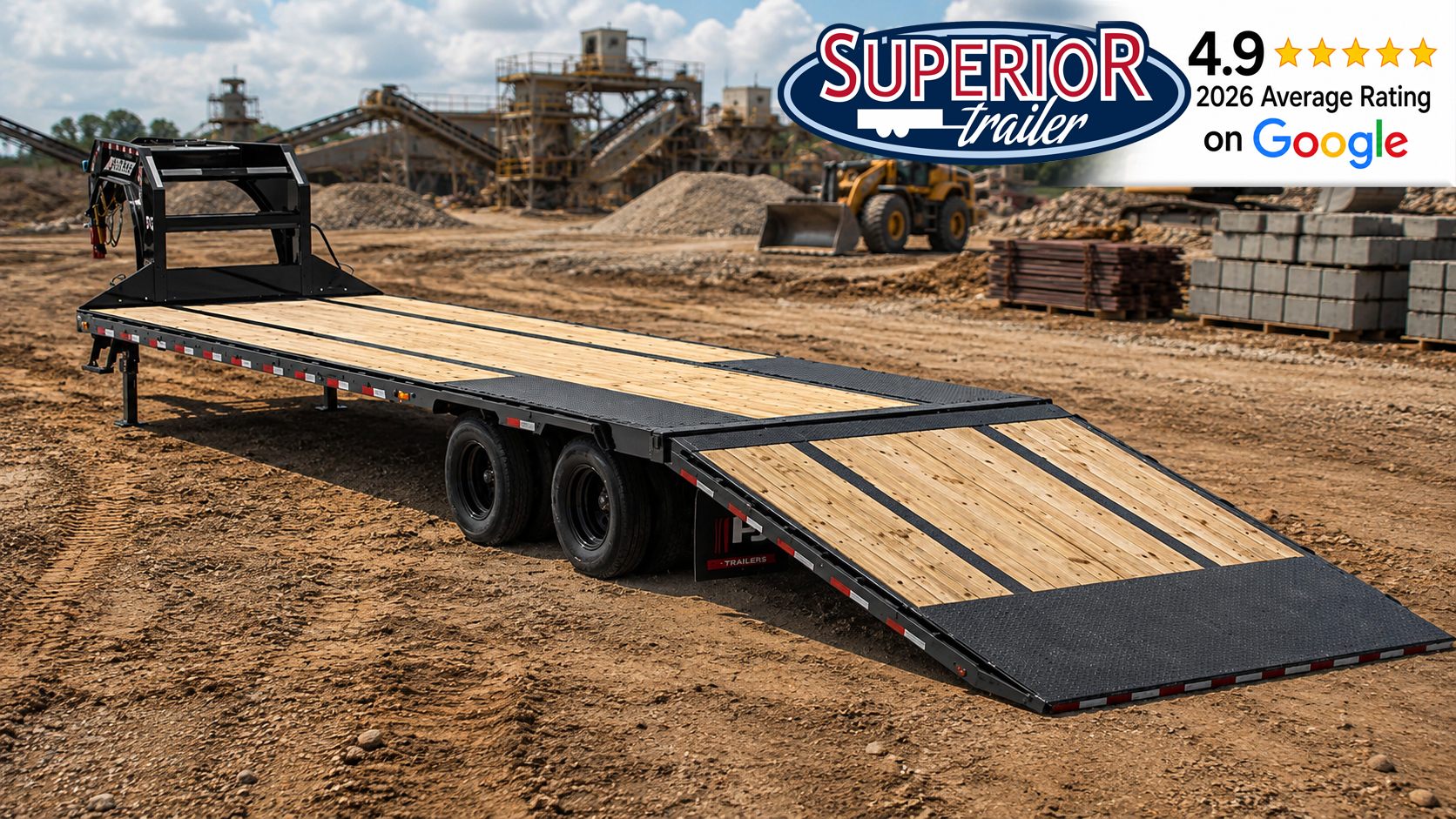
A PJ Trailers Low-Pro Hydraulic Dovetail and a standard equipment trailer both move wheeled or tracked equipment from one site to another, but they load very differently. People often assume the choice comes down to weight. It usually does not. Most of the time the deciding factors are how wide your load is, how long it is, and what you want to spend.
Superior Trailer carries PJ Trailers' Low-Pro Hydraulic Dovetail line alongside standard equipment trailers from Big Tex, LoadTrail, RawMaxx, Texas Bragg, and Anvil at our Burlington, NC, Richmond, Suffolk, and Virginia Beach, VA locations. The PJ hydraulic dovetail draws a specific kind of buyer: someone with equipment that is slow, low, or awkward to load up a fixed ramp, or a crew that wants to cut loading time and risk on every stop. Here is how the two trailer types differ and how to tell which one your work needs.
The Core Difference: How the Deck Gets Low
A standard equipment trailer loads over ramps that bridge the ground and a fixed-height deck. The loading angle comes down to how tall the deck is and how long the ramps are. That works fine for most equipment, but it becomes a problem for a machine with low ground clearance, small wheels, or poor traction.
PJ Trailers' Low-Pro Hydraulic Dovetail uses a different idea. The rear section of the deck, the dovetail, tilts down to ground level using hydraulic cylinders instead of relying on a fixed ramp angle. You drive equipment straight onto the trailer at a shallow, powered ramp angle, then raise the dovetail back to transport position. There is no separate ramp to unfold, position, or pin in place, and no steep transition for a low machine to high-center on. It is especially useful for equipment with poor traction or low ground clearance, such as skid steers, compact loaders, mini excavators, and rollers. The hydraulic dovetail cuts out manual ramps entirely, which speeds up loading and reduces the physical work of positioning ramps job after job.
Side-by-Side Comparison
| Feature | PJ Low-Pro Hydraulic Dovetail | Standard Equipment Trailer |
|---|---|---|
| Loading method | Hydraulic dovetail lowers the rear deck section to a shallow ground-level angle, no ramps to position | Tilt deck, fold-down ramps, mega ramps, or slide-in ramps |
| Loading surface | Powered ramp angle at ground level, no manual ramp handling | Climb a ramp to a fixed-height deck |
| GVWR range | Up to roughly 25,000 to 25,900 lbs on gooseneck models | About 4,500 to over 17,000 lbs on standard equipment trailers, higher on heavy-duty goosenecks |
| Deck width | 102 inches standard | 72 to 102 inches depending on model and fender configuration |
| Deck / dovetail length | Overall lengths from 16 to 44 ft, with the hydraulic dovetail section typically 10 to 12 ft of that | Commonly up to 24 ft, longer available on gooseneck configurations |
| Tow vehicle | One-ton or larger, gooseneck-capable truck for most configurations | Half-ton on the small end, one-ton or larger on the big end |
| Typical price | Roughly $26,000 to $45,000+ new, depending on length and capacity | Roughly $5,000 to $25,000, higher for heavy-duty gooseneck configs |
| Best for | Low, poor-traction, or awkward-to-ramp loads; faster one-crew loading | Wider budgets, lighter loads, or equipment that ramps easily |
Specifications vary by exact model and configuration. Confirm current specs and pricing with your Superior Trailer location before purchase.
Width, Length, and Budget Usually Decide It, Not Weight
The two trailer types overlap heavily on weight capacity. A PJ Low-Pro Hydraulic Dovetail gooseneck can run up to roughly 25,000 to 25,900 lbs GVWR, while a standard PJ or Big Tex equipment trailer commonly runs from about 4,500 lbs up to 17,000 lbs or more depending on axle configuration. So a lot of loads will physically ride on either one.
What separates them is shape and cost. A hydraulic dovetail trailer is a gooseneck configuration, which means it needs a heavier tow vehicle and a bigger up-front investment than a basic bumper-pull equipment trailer. A standard equipment trailer is also the cheaper way to move a machine that can handle a normal ramp angle without issue. The hydraulic dovetail earns its higher price when the load is hard to load any other way: low ground clearance, small wheels, poor traction, or a crew that needs to shave minutes off every load and unload throughout the day.
What Loads Well on Each Trailer Type
| Load | PJ Low-Pro Hydraulic Dovetail | Standard Equipment Trailer |
|---|---|---|
| Skid steer or compact track loader | Ideal, shallow powered ramp angle handles low clearance | Ramp angle and traction can be a problem on some models |
| Mini excavator | Ideal, easy to drive on without a steep climb | Works well within trailer's rated capacity |
| Smooth drum compactor or roller | Ideal, low ramp angle reduces slip risk | Difficult and risky on steep fixed ramps |
| Zero-turn mower or compact tractor | Works well, though often more trailer than needed | Yes, common landscape use, most cost-effective option |
| Full-size farm or construction equipment | Check GVWR and deck length against your machine | Better suited for lighter, more standard equipment |
| Wide or oversized loads | 102-inch deck width covers most needs | Wider configurations available with drive-over fenders |
How Standard Equipment Trailers Are Built
Equipment trailers load a few different ways. You can get a single-axle tilt deck, fold-down ramps, spring-assisted mega ramps that lay flat to extend the deck and run the full width, or slide-in ramps. That range lets you match the ramp to the equipment instead of the other way around.
Superior Trailer's equipment trailer lineup from Big Tex, LoadTrail, RawMaxx, Texas Bragg, and Anvil covers load capacities from about 4,500 lbs up to 17,000 lbs or more, with deck widths from 72 inches up to a full 102 inches on wider configurations. That range covers most landscaping, construction, and light equipment hauling needs at a lower price point than a hydraulic dovetail gooseneck.
What a Hydraulic Dovetail Is Built For
PJ Trailers' Low-Pro Hydraulic Dovetail is built around cutting loading time and loading risk. The powered dovetail means no ramp to unfold, position, or pin, and a shallow transition angle that low-clearance equipment can drive over without hanging up. For a crew loading and unloading at site after site all day, the time saved on every stop adds up. For equipment that is dangerous or slow to load on a fixed ramp, the hydraulic dovetail is the whole reason to own one.
If your equipment is low to the ground, has small wheels, or struggles for traction on a standard ramp, the PJ Low-Pro Hydraulic Dovetail is worth the higher price for the time and risk it saves on every job.
Pricing and Financing
Standard equipment trailers commonly run from about $5,000 to $25,000 depending on size, capacity, and ramp setup. PJ Trailers' Low-Pro Hydraulic Dovetail gooseneck models typically run from about $26,000 up to $45,000 or more depending on length and capacity. Both trailer types can be financed in-house at every Superior Trailer location: Burlington, NC, and Richmond, Suffolk, and Virginia Beach, VA.
If you are buying either one for business use, ask about Section 179, which can allow a full first-year deduction on a business-use trailer. Confirm the details with your CPA, since how much you can write off depends on your tax situation.
Frequently Asked Questions
What is a hydraulic dovetail trailer? A hydraulic dovetail trailer has a rear deck section that tilts down to a shallow, ground-level ramp angle using hydraulic cylinders, instead of relying on fixed fold-down or slide-in ramps.
Is a hydraulic dovetail trailer better than a standard equipment trailer? It depends on the load. A hydraulic dovetail is better for low-clearance or poor-traction equipment and for crews that want faster loading. A standard equipment trailer is more cost-effective for equipment that ramps easily.
How much does a PJ Trailers Low-Pro Hydraulic Dovetail cost? New units typically run from about $26,000 to $45,000 or more depending on length and GVWR. Confirm current pricing at your Superior Trailer location.
What GVWR does a PJ Low-Pro Hydraulic Dovetail carry? Gooseneck models are available up to roughly 25,000 to 25,900 lbs GVWR, depending on axle configuration.
Does Superior Trailer offer financing on equipment trailers? Yes, financing is available in-house at every Superior Trailer location for both hydraulic dovetail and standard equipment trailers.
Which brands does Superior Trailer carry for equipment trailers? Big Tex, LoadTrail, RawMaxx, Texas Bragg, and Anvil, alongside PJ Trailers' hydraulic dovetail line.
Where can I buy a PJ Trailers Low-Pro Hydraulic Dovetail? Superior Trailer carries PJ Trailers at all four locations: Burlington, NC, and Richmond, Suffolk, and Virginia Beach, VA.
Need Help Deciding?
Our team can walk you through available new and used inventory and help match the right trailer to your needs and budget.
Contact us today →
