
Gooseneck Trailer Buying Guide: Choosing the Right Capacity, Deck, and Price
Buying Guide • July 2026 • 17 min read
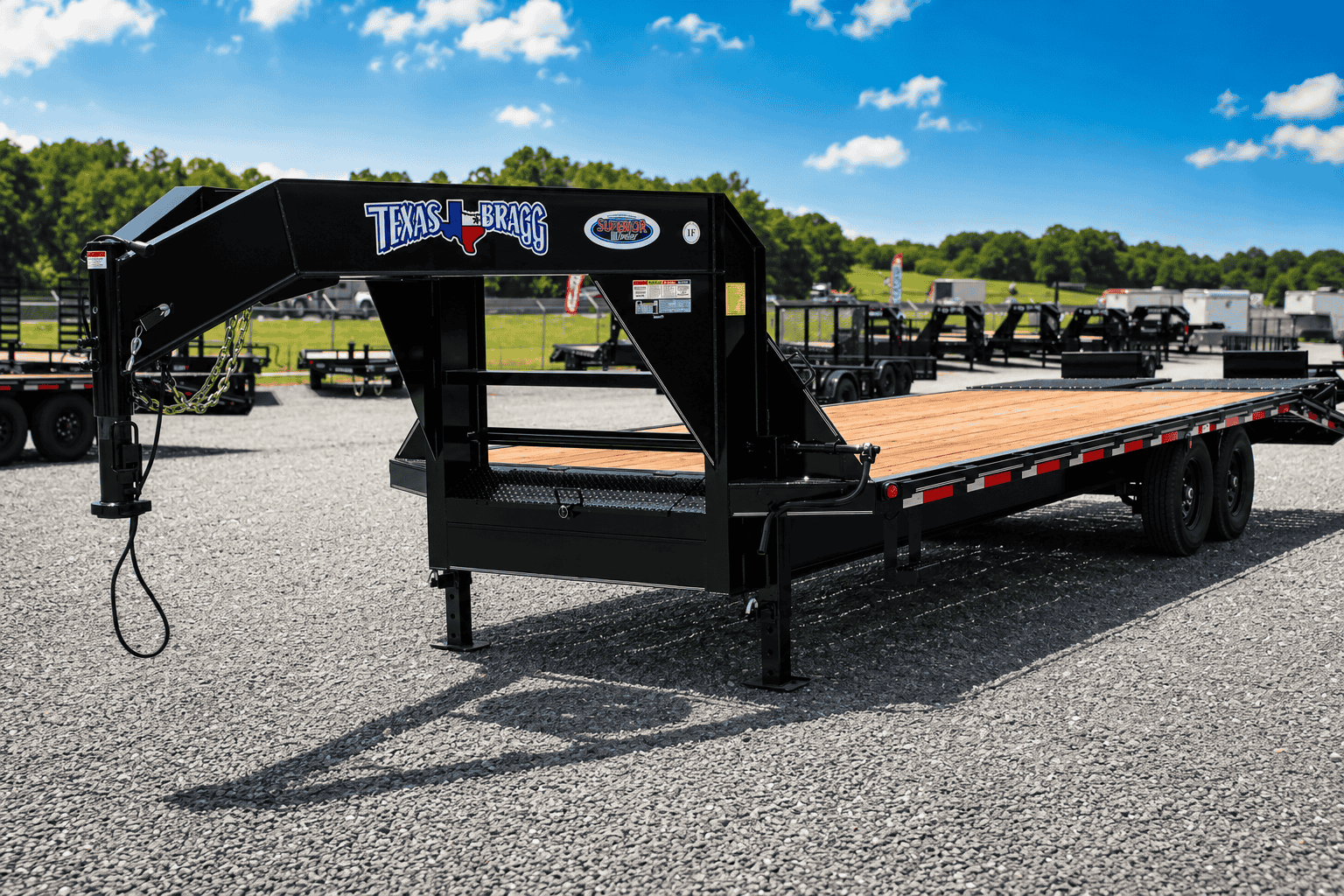
A gooseneck trailer can completely change what your truck and business are capable of hauling. It can also become an expensive mistake when the trailer is chosen by appearance, axle size, or deck length without checking the numbers that actually control the load.
That happens more often than most buyers realize.
Someone sees a 20K sticker and assumes the trailer can carry 20,000 pounds of equipment. Another buyer checks the truck’s advertised towing capacity but forgets about payload and rear-axle limits. Someone else buys a long straight-deck trailer, only to find that the loading angle is too steep for the machine they move every day.
The right gooseneck trailer is not automatically the largest or most expensive one on the lot. It is the trailer that matches your truck, your heaviest realistic load, the way you load that equipment, and the amount of work you expect the trailer to handle.
Superior Trailer helps contractors, equipment operators, landscapers, farmers, business owners, and commercial haulers compare those details before buying. With trailer sales, financing, parts, and service available through locations in Virginia Beach, Richmond, Suffolk, and Burlington, you can shop for the trailer and continue receiving support after it leaves the lot.
The Quick Answer: Which Gooseneck Configuration Is Best?
For most buyers, the choice comes down to how the trailer will be loaded.
Choose a straight-deck gooseneck when you primarily haul lumber, pipe, pallets, building materials, or equipment that can be loaded with removable ramps.
Choose a dovetail with flip-over or Mega Ramps when you regularly move skid steers, tractors, mini excavators, vehicles, or other equipment that needs a lower approach angle.
Choose a hydraulic dovetail when you load and unload several times a day and want to eliminate most of the lifting and positioning required by manual ramps.
Choose a tilt-deck gooseneck when drive-on loading is the priority and your load pattern works with the available stationary and tilting deck space.
Choose a tandem-dual or heavier commercial model when the load, operating schedule, or distance requires more capacity than a standard tandem-single-wheel trailer can provide.
Those answers are only the starting point. The truck and trailer ratings still have to work together.
Why Buyers Move From a Bumper-Pull to a Gooseneck
A gooseneck trailer connects inside the truck bed, with the hitch point positioned near or over the rear axle. A conventional bumper-pull connects behind the truck.
That change in hitch position can make a noticeable difference when towing long, heavy, or awkward loads. A properly matched gooseneck generally feels more settled because the connection is not hanging several feet behind the truck’s rear axle. Drivers often prefer the way a gooseneck tracks, turns, and responds when backing.
However, a gooseneck is not automatically safer simply because it has a gooseneck coupler. The trailer must still be loaded correctly, the hitch must be properly rated, and the truck must have enough payload, axle capacity, tire capacity, braking ability, and gross combined weight capacity for the job.
The National Highway Traffic Safety Administration recommends checking the loaded trailer’s hitch weight against the tow vehicle’s axle ratings and obtaining towing guidance from the vehicle and trailer manufacturers.
Start With the Load, Not the Trailer
Before comparing brands or prices, write down what the trailer will actually carry.
Do not use only the machine’s advertised operating weight. Include attachments, buckets, forks, fuel, spare tires, chains, binders, toolboxes, winches, additional equipment, and anything else that will ride on the trailer.
For example, a skid steer may fit comfortably within the trailer’s estimated payload. Once a heavy bucket, grapple, pallet forks, fuel tank, chains, tools, and another attachment are added, the total can be much closer to the trailer’s limit than expected.
Your buying target should be based on the heaviest realistic load you expect to move—not the lightest machine you own today.
Leaving some usable capacity also gives the business room to grow. Buying a trailer that is already operating at its limit can force another purchase when you add a larger machine, heavier attachment, or second piece of equipment.
Understanding GVWR and Actual Payload
GVWR stands for Gross Vehicle Weight Rating. It is the maximum rated weight of the loaded trailer, including the trailer itself and everything placed on it.
GVWR is not the same as cargo capacity.
Use this basic calculation:
Trailer GVWR − empty trailer weight = estimated payload capacity
A trailer rated at 20,000 pounds that weighs 6,000 pounds empty would have approximately 14,000 pounds available for cargo.
That figure can still be affected by installed options and the trailer’s final certified specifications. Hydraulic dovetails, winches, spare tires, toolboxes, heavier flooring, additional ramps, and other upgrades add weight to the trailer. Always check the actual VIN label, manufacturer information, and listed empty weight for the specific unit you are purchasing.
Do not assume that two trailers with the same axle ratings have the same legal GVWR or payload. Frame design, suspension, tires, wheels, coupler, brakes, and manufacturer certification all matter.
Common Gooseneck Capacity Classes
14K to 16K Gooseneck Trailers
These models are a popular step up for buyers who need more deck space and stability but do not need a tandem-dual commercial trailer.
They may work well for compact tractors, lighter skid steers, smaller construction machines, vehicles, landscaping equipment, building materials, and general farm use. The actual payload must still be calculated after subtracting the trailer’s empty weight.
A 16K gooseneck can also be attractive to buyers who want a longer deck without moving immediately into the additional weight and cost of a 20K or 25K trailer.
20K Gooseneck Trailers
A 20K gooseneck is one of the most versatile choices for contractors and equipment owners. These trailers are commonly configured with longer decks, heavier frames, larger axles, substantial ramp systems, and commercial tie-down features.
They can be a strong fit for construction equipment, tractors with attachments, multiple smaller machines, vehicles, pallets, pipe, and building materials.
The “20K” rating still does not mean the trailer can carry 20,000 pounds of cargo. Empty trailer weight must be subtracted first.
24K to 25.9K Gooseneck Trailers
This range is often considered by buyers moving heavier equipment or using the trailer frequently for commercial work.
Models in this class may use tandem dual wheels, heavier suspension components, stronger frames, larger jacks, heavier couplers, and more substantial braking systems.
At this level, truck selection becomes especially important. A trailer may be capable of handling the load while the truck exceeds its payload, rear-axle, tire, or combination-weight rating.
30K to 40K Gooseneck Trailers
These trailers are built for demanding commercial and industrial hauling. Depending on the model, they may use tandem-dual or triple-axle arrangements, upgraded suspension, air-ride options, hydraulic jacks, hydraulic dovetails, and decks extending beyond 40 feet.
Current manufacturer offerings demonstrate how broad this category has become. Big Tex lists heavy-duty gooseneck models with ratings around 30,000 pounds, while Diamond C offers select gooseneck configurations reaching 40,000 pounds GVWR and lengths up to 44 feet.
These are specialized trailers. Before purchasing one, confirm licensing, insurance, registration, commercial operating requirements, truck ratings, and the laws that apply to the work you perform.
Straight-Deck Gooseneck Trailers
A straight deck stays level from the main deck to the rear edge.
This configuration works especially well for:
- Lumber
- Pipe
- Palletized material
- Building supplies
- Hay
- Vehicles or equipment loaded with removable ramps
- Loads that need the full deck to remain flat
Straight decks are simple, versatile, and usually less expensive than hydraulic configurations.
The tradeoff appears during equipment loading. Without a dovetail, the ramps may meet the deck at a steeper angle. Low-clearance machines can drag, high-center, or struggle to transition onto the deck.
Slide-in ramps also have to be removed, positioned, lifted, and stored. That may be reasonable for occasional loading but frustrating for a crew doing it several times every day.
Dovetail Gooseneck Trailers
A dovetail lowers the rear section of the trailer, reducing the loading angle between the ground, ramp, and main deck.
It is a practical choice for:
- Skid steers
- Compact tractors
- Mini excavators
- Scissor lifts
- Trenchers
- Rollers
- Vehicles
- Landscaping equipment
Ramp width matters almost as much as ramp capacity. Narrow ramps can work for machines with predictable wheel or track spacing. Wider ramps provide more freedom when loading different machines and can make the process less stressful in poor weather or uneven terrain.
Big Tex, for example, offers gooseneck configurations with dovetails, spring-assisted flip-over ramps, Mega Ramps, and rear slide-in ramps, depending on the model.
Ask how the ramps sit when folded. Some ramp systems stand upright and create wind resistance. Others lay flat and can become part of the usable deck. The best design depends on what you haul and whether you need every foot of deck space.
Hydraulic Dovetail Gooseneck Trailers
A hydraulic dovetail lowers and raises using the trailer’s hydraulic system.
The main advantage is not simply appearance. It saves physical effort and time.
For an owner-operator who unloads once in the morning and reloads once at the end of the day, manual ramps may be perfectly reasonable. For a crew moving machines between several jobs, the hydraulic system can remove repeated lifting, ramp alignment, pin handling, and manual setup.
A hydraulic dovetail can be especially valuable when:
- Equipment is loaded several times a day
- Different machines have different track widths
- The operator frequently works alone
- Manual ramps are unusually heavy
- Fast loading affects daily productivity
- The trailer also needs to haul flat-deck cargo
Hydraulic systems add purchase cost, trailer weight, wiring, batteries, cylinders, and maintenance points. The convenience must be worth those additions.
Diamond C currently offers hydraulic dovetail options with low approach angles and wireless operation on selected heavy-duty gooseneck models. Big Tex also offers hydraulic-dovetail gooseneck configurations for equipment and material hauling.
Tilt-Deck Gooseneck Trailers
A tilt trailer lowers the loading end of the deck without requiring conventional removable ramps.
Depending on the model, the entire deck may tilt, or the trailer may combine a stationary front deck with a tilting rear deck.
Tilt trailers are useful for equipment and vehicles that can drive or winch onto the deck. They reduce ramp handling and can produce a clean loading path.
Before choosing one, check:
- How much of the deck tilts
- How much stationary deck remains
- Whether the tilt is gravity-operated or hydraulic
- The loading angle
- Whether more than one machine can be positioned correctly
- How the deck locks for transport
- Whether the pivot placement works with your normal load
A tilt deck is convenient, but it is not automatically the best choice for mixed loads. A buyer carrying attachments, pallets, and multiple machines may prefer the flexibility of a conventional deck with ramps.
Deck Length: Understanding Measurements Such as 25+5 and 30+5
Gooseneck trailers are commonly described with measurements such as 25+5 or 30+5.
A 25+5 configuration generally means approximately 25 feet of main deck plus a 5-foot dovetail. A 30+5 generally provides approximately 30 feet of main deck plus a 5-foot dovetail.
Verify how each manufacturer measures its deck. Do not assume that every advertised foot is level, usable main-deck space.
Think about:
- The machine’s full length
- Buckets and attachments
- Where the load must sit for proper balance
- Whether a second machine will be carried
- Room for chains and binders
- Whether ramps fold onto the deck
- Future equipment purchases
- Tail swing and maneuverability
A longer trailer offers flexibility but also adds empty weight, cost, turning space, storage requirements, and the possibility of carrying more cargo than the truck can safely support.
Trailer Width and Deck Height
Many heavy equipment and commercial gooseneck trailers use a deck width around 102 inches, but the usable loading surface and fender arrangement vary.
A deck-over trailer places the deck above the tires. This creates a flat, wide loading surface without fenders interrupting the deck. The compromise is a higher deck and potentially steeper loading angle.
A low-profile design may improve loading clearance and stability, but frame structure, axle placement, tire size, and suspension design all affect the final deck height.
Measure the widest point of the equipment—not only the tires or tracks. Buckets, attachments, mirrors, steps, and outriggers may be wider than the machine’s listed body width.
Axles, Wheels, and Suspension
Gooseneck trailers may be built with tandem single-wheel, tandem dual-wheel, or triple-axle configurations.
Tandem Single-Wheel
Tandem single-wheel trailers are lighter and often cost less. They can be a good match for moderate equipment loads, farm work, landscaping, vehicles, and general contracting.
Tandem Dual-Wheel
Tandem-dual trailers use dual wheels on each side of each axle. They are commonly selected for heavier commercial loads.
Advantages may include higher capacity, greater tire contact, and added support for demanding work. The disadvantages include more tires to purchase and maintain, more trailer weight, and a higher initial price.
Triple Axle
Triple-axle trailers can provide additional capacity and load distribution on certain heavy-duty models. They may also create more tire scrub during tight turns and increase tire, brake, bearing, and suspension maintenance.
Suspension
Spring suspension remains common because it is proven, serviceable, and widely understood. Torsion and air-ride systems are available on certain trailers and may provide benefits for specialized loads or long-distance use.
Do not choose an axle configuration from its advertised capacity alone. Ask about the certified trailer GVWR, individual axle ratings, tire ratings, wheel ratings, suspension capacity, brake type, and replacement-part availability.
Your Truck’s Tow Rating Is Only One Part of the Decision
A truck may have enough advertised towing capacity and still be a poor match for a particular gooseneck.
Check all of the following:
- Truck GVWR
- Truck payload
- Front and rear gross axle weight ratings
- Gross combined weight rating
- Maximum gooseneck towing capacity
- Hitch-ball and coupler rating
- Bed and hitch installation requirements
- Tire and wheel load ratings
- Passenger and cargo weight
- Fuel, tools, auxiliary tanks, and bed-mounted equipment
The gooseneck transfers substantial weight into the truck bed. That weight becomes part of the load carried by the truck.
A diesel engine, four-wheel-drive system, crew cab, long bed, large fuel tank, toolbox, passengers, and aftermarket equipment can all reduce the payload remaining for the trailer’s hitch weight.
Use the truck’s door label, owner’s manual, manufacturer towing guide, and VIN-specific information. Do not rely only on the maximum number shown in an advertisement for the truck model.
The lowest-rated part of the complete combination becomes the practical limit.
Should You Buy More Trailer Than You Need?
Buying slightly above today’s requirement can make sense when you know the business is adding larger equipment.
Buying far above the need can create unnecessary problems.
A heavier trailer reduces available cargo capacity, may require a larger truck, costs more to register and maintain, uses more fuel, and can be harder to maneuver. The larger trailer may also move the combination into additional licensing or commercial compliance requirements.
The best approach is to leave a reasonable capacity margin without jumping into a completely different equipment class unnecessarily.
How Much Does a Gooseneck Trailer Cost?
Gooseneck trailer prices vary widely based on:
- GVWR
- Deck length
- Axle configuration
- Brand
- Ramp style
- Hydraulic systems
- Jacks
- Suspension
- Flooring
- Winches
- Toolboxes
- Tires and wheels
- Electrical equipment
- Optional finishes and accessories
As of July 2026, examples shown in Superior Trailer’s Burlington inventory included a 25-foot PJ low-profile gooseneck with Monster Ramps listed at $12,999, a Texas Bragg 25+5 16K gooseneck flatbed listed at $13,599, and a Texas Bragg 30+5 20K gooseneck listed at $15,899. Inventory and prices can change, so current availability and out-the-door pricing should always be confirmed with the dealership.
Heavy tandem-dual, hydraulic-dovetail, air-ride, and 30K-to-40K commercial configurations can cost considerably more. Selected manufacturer base prices for highly equipped heavy-duty models can reach or exceed the $30,000 range before additional options.
Do not compare two trailers by price until you have compared the complete specifications. A less expensive trailer may have a shorter deck, lower GVWR, lighter frame, smaller jacks, different tires, manual ramps, or fewer included features.
Financing a Gooseneck Trailer
Financing can help preserve cash for equipment, payroll, repairs, materials, and other operating expenses.
Superior Trailer works with financing and rent-to-own relationships for new and used trailer purchases. Available programs, approvals, down payments, rates, and terms depend on the applicant, lender, trailer, and current program requirements.
When comparing financing, look beyond the monthly payment. Review:
- Total amount financed
- Down payment
- Interest rate
- Loan term
- Total finance cost
- Early payoff rules
- Required insurance
- Documentation fees
- Whether accessories can be included
- Whether the trailer will be titled personally or through the business
Business buyers should also speak with a qualified tax professional about depreciation and Section 179 eligibility. IRS Publication 946 lists a maximum Section 179 expense deduction of $2,560,000 for tax years beginning in 2026, subject to phase-outs, taxable-income restrictions, qualifying-use requirements, and other rules. A trailer is not automatically deductible simply because it was financed or purchased through a business.
Do You Need a CDL to Pull a Gooseneck Trailer?
A heavy trailer does not automatically mean every driver needs a Class A CDL, but the combination ratings can trigger CDL requirements.
Under federal Class A standards, the threshold generally involves a combination rated at 26,001 pounds or more when the towed unit is rated above 10,000 pounds. Virginia and North Carolina publish similar Class A definitions. Commercial use, actual weights, exemptions, interstate operation, medical requirements, and state licensing rules can affect the final answer.
A combination can also be subject to commercial motor carrier rules below the CDL threshold. Buyers using a trailer for business should check with their state DMV, insurer, and applicable motor carrier authority before operating.
Superior Trailer can help explain trailer specifications, but licensing and legal compliance should be confirmed with the appropriate government agency.
Important Features Worth Comparing
Ramps
Check ramp length, width, weight rating, spring assistance, traction surface, storage location, and whether the ramps lie flat.
Jacks
Heavy goosenecks may use dual manual jacks, two-speed jacks, or hydraulic jacks. Buyers who connect and disconnect frequently may benefit from powered jacks.
Flooring
Treated wood remains common and practical. Specialized flooring may provide additional traction, durability, or resistance to equipment damage.
Tie-Down Points
Look for stake pockets, rub rails, chain spools, D-rings, toolboxes, and enough working room to secure the load correctly.
Winch Preparation
A winch plate, battery box, charging system, remote control, and fairlead location can be useful for disabled equipment and vehicles.
Spare Tire
Confirm whether a spare is included, where it mounts, and whether it matches the trailer’s tire and wheel specifications.
Toolbox Storage
Neck-mounted toolboxes are useful for straps, chains, binders, blocks, gloves, grease, and other equipment. Make sure the toolbox does not interfere with the truck during sharp turns.
Brakes
Confirm the brake type and whether the truck’s brake controller is compatible. Heavy commercial configurations may use systems different from common light-duty electric trailer brakes.
New Versus Used Gooseneck Trailers
A used gooseneck can be a good value, but heavy trailers often live hard working lives.
Inspect:
- Main frame and neck structure
- Welds and previous repairs
- Deck condition
- Crossmembers
- Coupler wear
- Safety chains
- Breakaway system
- Jacks
- Suspension
- Equalizers and bushings
- Axle alignment
- Wheel bearings
- Tires and date codes
- Brakes
- Wiring
- Lights
- Hydraulic cylinders, pumps, hoses, and batteries
- Ramp hinges, springs, pins, and latches
- VIN label and title information
Uneven tire wear can point to alignment, axle, suspension, loading, or frame problems. Fresh paint is not proof that the structure underneath is sound.
A professional inspection is especially important when buying a high-capacity trailer that will immediately return to commercial service.
What Gooseneck Trailer Is Best for a Contractor?
A contractor moving skid steers, mini excavators, attachments, and materials will often benefit from a 20K-or-higher dovetail gooseneck with wide ramps, substantial tie-down points, toolbox storage, and enough deck length to balance different machines.
The exact rating should be based on actual equipment weights and the truck’s ratings.
What Gooseneck Trailer Is Best for Landscaping?
A landscaper moving compact tractors, skid steers, mini skid steers, attachments, pallets, and materials may prefer a 14K, 16K, or 20K model.
A dovetail or wide ramp system usually makes more sense when machines are loaded daily. A straight deck can work when materials are the primary cargo and equipment loading is less frequent.
What Gooseneck Trailer Is Best for Farming?
Farm use varies too much for a single answer. A farmer moving hay and pallets may prefer a long straight deck. A buyer moving tractors may need a dovetail or hydraulic loading system. Someone moving several pieces of equipment may need additional deck length and a higher GVWR.
Measure the tractor with its attachments installed. A loader bucket, rotary cutter, hay spear, or other implement can add several feet to the required deck length.
What Gooseneck Trailer Is Best for Hotshot Work?
Hotshot buyers often prioritize low empty weight, usable deck length, axle configuration, tire availability, cargo securement, durability, and the ability to operate within legal weight limits.
Trailer capacity is only part of the calculation. The truck, trailer, fuel, passengers, tools, chains, tarps, and cargo all contribute to the combination’s weight.
Commercial operators should verify insurance, apportioned registration, operating authority, electronic logging, medical-card, and CDL requirements as applicable to their operation.
Questions to Answer Before You Buy
Before choosing a trailer, be able to answer these questions:
- What is the heaviest complete load I expect to carry?
- What does the trailer weigh empty with its installed options?
- What is the trailer’s certified GVWR?
- What is my truck’s VIN-specific gooseneck towing capacity?
- How much truck payload remains after passengers, fuel, tools, and accessories?
- What are the truck’s front and rear axle ratings?
- Do I need a straight deck, dovetail, tilt, or hydraulic dovetail?
- How often will the trailer be loaded and unloaded?
- What loading angle does my equipment require?
- How much deck space is needed for attachments and proper weight placement?
- Will the combination require a CDL or other commercial compliance?
- Do I need financing, service support, or additional accessories?
When those questions are answered honestly, the correct trailer usually becomes much easier to identify.
Why Buy a Gooseneck Trailer From Superior Trailer?
A gooseneck trailer is working equipment. The dealership relationship should not end when the paperwork is signed.
Superior Trailer provides access to new and pre-owned trailers, financing options, replacement parts, routine maintenance, brake and axle service, electrical repairs, structural work, and other trailer support through four Virginia and North Carolina locations.
Our team can help you compare:
- GVWR and estimated payload
- Deck lengths
- Straight-deck and dovetail configurations
- Ramp systems
- Tandem-single and tandem-dual models
- Truck and hitch considerations
- Current inventory
- Financing options
- Parts and accessories
- Ongoing service needs
Instead of trying to make a trailer work after purchasing it, bring us the truck information and the specifications for the equipment you plan to haul. We will help you narrow the choices before you commit.
Visit Superior Trailer in Virginia or North Carolina
Burlington, North Carolina
812 Plantation Drive
Burlington, NC 27215
336-222-0444
Virginia Beach, Virginia
4999 Euclid Road
Virginia Beach, VA 23462
757-497-5557
Richmond, Virginia
7100 U.S. Route 1
Richmond, VA 23237
804-275-5557
Suffolk, Virginia
3468 Pruden Boulevard
Suffolk, VA 23434
757-809-5515
Location information is current as listed by Superior Trailer in July 2026.
Find the Right Gooseneck Without Guessing
A properly selected gooseneck trailer can serve a business for years. A mismatched trailer can overload the truck, waste payload, slow down loading, damage equipment, and force an early replacement.
Start with the real load. Calculate the trailer’s usable payload. Verify every truck rating. Decide how the equipment needs to enter and leave the deck. Then compare price, convenience, and long-term service.
Browse current gooseneck trailer inventory or contact the Superior Trailer location nearest you. Our team will help you compare available models and find a trailer that fits the work you are doing now—and the work you plan to take on next.
Frequently Asked Questions About Gooseneck Trailers
How much weight can a gooseneck trailer carry?
It depends on the trailer’s certified GVWR and empty weight. Subtract the empty trailer weight from the GVWR to estimate available payload. Never treat the advertised GVWR as cargo capacity.
Is a gooseneck better than a bumper-pull trailer?
A gooseneck is often preferred for long, heavy, or commercial loads because the hitch is positioned in the truck bed near the rear axle. Bumper-pull trailers remain useful for lighter loads, lower purchase costs, and trucks without an in-bed hitch.
Can a three-quarter-ton truck pull a gooseneck trailer?
Some three-quarter-ton trucks can tow certain gooseneck trailers, but the answer depends on the truck’s exact configuration, payload, axle ratings, gross combined weight rating, hitch rating, and the loaded trailer weight. Check VIN-specific manufacturer information.
Can a one-ton single-rear-wheel truck pull a tandem-dual trailer?
It may be able to tow certain tandem-dual trailers, but trailer type alone does not determine compatibility. The truck must remain within its payload, axle, tire, hitch, towing, and combination-weight ratings.
What is the difference between a 20K trailer and 20,000 pounds of payload?
A 20K trailer generally has a GVWR of approximately 20,000 pounds. Its empty weight must be subtracted from that rating. If the trailer weighs 5,500 pounds empty, the estimated cargo capacity would be approximately 14,500 pounds.
Is a hydraulic dovetail worth the additional cost?
It may be worthwhile for operators who load several times per day, work alone, move different machines, or want to reduce manual ramp handling. Occasional users may prefer the lower cost and simplicity of spring-assisted ramps.
What is the best gooseneck trailer length?
There is no universal best length. Measure the equipment with its attachments installed, include room for correct weight placement and securement, and consider future equipment purchases. Common configurations include 25+5 and 30+5 trailers.
Do I need a CDL for a 20K gooseneck?
Possibly. CDL requirements depend on the ratings of the entire combination, commercial use, applicable exemptions, and state and federal rules. A Class A CDL is generally associated with a combination rated at 26,001 pounds or more when the towed unit exceeds 10,000 pounds, but the complete situation must be verified.
Does Superior Trailer finance gooseneck trailers?
Superior Trailer provides access to financing and rent-to-own relationships for qualifying new and used trailer purchases. Approval, terms, rates, and available programs are determined by the applicable financing provider.
Does Superior Trailer service gooseneck trailers?
Superior Trailer offers trailer parts and service support, including maintenance and repair requests through its Burlington, Virginia Beach, Richmond, and Suffolk locations.
Need Help Choosing the Right Size?
Our team can help you compare sizes, weight ratings, and options to find the best trailer for your needs.
Contact us today →
